
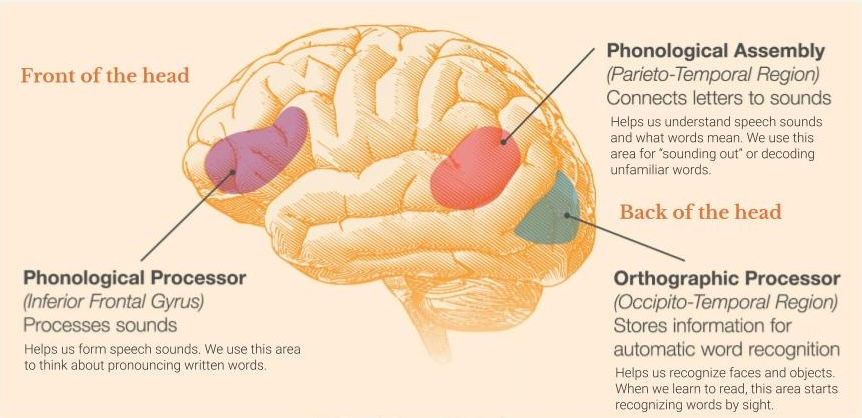
The brain utilizes three key regions for reading.
At the front of the brain is our Phonological Processor region that processes sounds; it helps us form speech sounds. We use this area to think about pronouncing written words.
How We Learn to Read
The middle of the brain holds our Phonological Assembly. It connects letters to sounds for decoding, and helps us understand speech sounds and what words mean. We use this area for “sounding out” or decoding unfamiliar words.
The task of reading is to transform visual script into language in order to construct meaning.
Unlike speaking, reading must be learned at a conscious level.
But there is no single location within the brain that serves as a “reading center,” so brain regions in the left hemisphere that serve other functions end up being redirected for reading
The back of the brain behaves like an Orthographic Processor. It helps us recognize faces and objects. When we learn to read, this area stores information and helps us with automatic word recognition.